
Excavations at Knowth - Volume 3

Knowth and the Zooarchaeology of Early Christian Ireland by Finbar McCormick and Emily Murray with contributions by George Eogan, Sheila Hamilton-Dyer and Eileen Murphy.
This is the third volume of the comprehensive account of the excavations at Knowth - part of the ancient Brú na Bóinne complex that also includes Dowth and Newgrange. This monograph provides the first comprehensive overview of the archaeological evidence for the use of animal resources in Ireland during the Early Christian period. The study of the bone assemblage from Knowth, one of the largest assemblages of animal bone recovered from an Irish site in recent decades, provided an opportunity to review the faunal data recorded from other Early Christian sites in Ireland. The volume contains a gazetteer summarising this data from more than 30 excavations across the country. The concluding premise of the analysis is that the animal bones demonstrate a fundamental shift in Irish livestock economy from the eighth century AD onwards.
Purchase at Amazon.com or Amazon.co.uk
Keynotes
- This is the third in the Excavations at Knowth series of monographs.
- It provides the first comprehensive overview of the archaeological evidence for the use of animal resources in Ireland during the Early Christian period.
- Excavations of the Early Christian levels at Knowth produced one of the largest assemblages of animal bone recovered from an Irish site in recent decades.
- The study of the bones provided an opportunity to review the faunal data recorded from contemporary Irish sites, and the volume contains a gazetteer summarising this evidence from more than 30 excavations across the country.
- This volume also contains chapters dealing with Irish zooarchaeology from the Mesolithic to the Iron Age and an overview of the Early Christian archaeology at Knowth. The concluding premise of the analysis is that the animal bones demonstrate a fundamental shift in the Irish livestock economy from the eighth century onwards.
Excavations at Knowth Series
A major programme of archaeological excavation commenced on 18 June 1962 at the passage tomb cemetery at Knowth in the Boyne Valley. This research excavation continued on a seasonal basis for more than 40 years, resulting in the excavation of a considerable area of the monument complex. Knowth is a multi-period and multi-functional archaeological complex. It is part of the ancient Brú na Bóinne complex that also includes Dowth and Newgrange and is now a UNESCO World Heritage Site.
Knowth had a long, though not continuous, history of both ritual and settlement that spanned some six millennia, from the beginning of the Neolithic to the modern era. The monuments at Knowth represent not just local expressions of ideas and ritual practices spread over extensive geographical areas of western and northern Europe, but also some of the most impressive architectural and engineering developments.
Volume 1 was published in 1984, it dealt with aspects of prehistoric activity at Knowth.
Volume 2 reported on further aspects of the prehistoric settlement excavated after 1989.
Volume 3 dealt with the animal bone assemblage from Knowth.
Volume 4 explored the historical role of Knowth and wider Brú na Bóinne.
Volume 5 presented the artefacts found at Knowth from the first and second millennia AD.
Volume 6 dealt with the archaeological history of the achievements of the Knowth passage tomb builders who constructed and used the Great Mound (Tomb 1) at Knowth.
Volume 7 dealt with the megalithic art from Knowth.
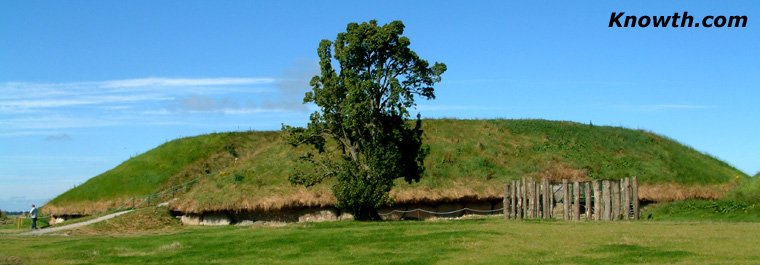 The Great Mound at Knowth.