
Excavations at Knowth - Volume 1
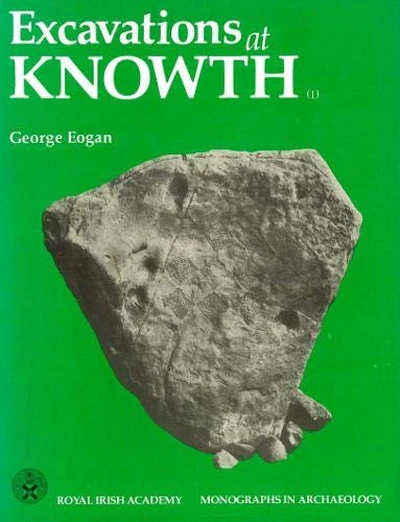
Excavations at Knowth - Smaller Passage Tombs, Neolithic Occupation and Beaker Activity
Excavations at Knowth, directed by George Eogan, began in 1962. This volume is the first in the Excavations at Knowth series from the Royal Irish Academy. It focuses on prehistoric settlement at Knowth, including the smaller passage tombs, Neolithic occupation and Beaker activity at the site.
Purchase at Amazon.com or Amazon.co.uk
The first part of the book describes the excavation of 19 smaller passage tombs surrounding the Great Mound. Although many had been damaged over time, the excavations showed that cremation was the main burial practice. Archaeologists found cremated human remains, simple grave goods such as beads, pins and pendants, and examples of Carrowkeel pottery. Some of these tombs were built before the Great Mound itself, showing that Knowth was already an important burial place before the construction of its largest monument.
The second part examines a Neolithic settlement beside the Great Mound. Archaeologists uncovered evidence of timber buildings, fences, hearths, pits and flint-working areas, suggesting that people lived and worked at Knowth as well as buried their dead there. Finds such as pottery, stone tools and arrowheads provide a glimpse into everyday life around 5,000 years ago.
The final section explores evidence from the Beaker period, around 2500 to 2000 BC. By this time, Knowth was no longer being used to build passage tombs, but people had returned to live and work among the ancient monuments. Their houses, fireplaces and distinctive Beaker pottery show that the site remained an important place long after the Neolithic builders had gone.
Together, these discoveries demonstrate that Knowth was far more than a single passage tomb. It was a ceremonial centre, a cemetery and a settlement that evolved over many centuries, making it one of the most significant archaeological landscapes in Ireland and Europe.
Excavations at Knowth Series
A major programme of archaeological excavation commenced on 18 June 1962 at the passage tomb cemetery at Knowth in the Boyne Valley. This research excavation continued on a seasonal basis for more than 40 years, resulting in the excavation of a considerable area of the monument complex. Knowth is a multi-period and multi-functional archaeological complex. It is part of the ancient Brú na Bóinne complex that also includes Dowth and Newgrange and is now a UNESCO World Heritage Site.
Knowth had a long, though not continuous, history of both ritual and settlement that spanned some six millennia, from the beginning of the Neolithic to the modern era. The monuments at Knowth represent not just local expressions of ideas and ritual practices spread over extensive geographical areas of western and northern Europe, but also some of the most impressive architectural and engineering developments.
Excavations at Knowth - Book Launch
Photo from the book launch of Volume 1 - Excavations at Knowth at the Royal Irish Academy in Dublin, printed in The Irish Times, Friday April 6, 1984. Photo by Eddie Kelly.
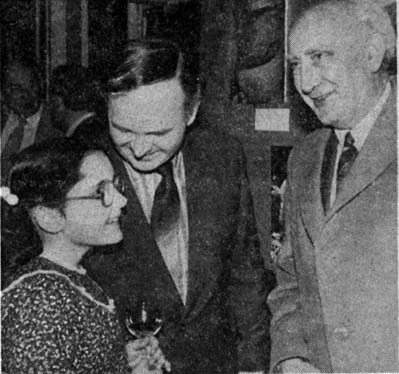 The author, Professor George Eogan (centre), his daughter Maeve, and Joe Bermingham.
Excavations at Knowth Book Series
Volume 1 was published in 1984, it dealt with aspects of prehistoric activity at Knowth.
Volume 2 reported on further aspects of the prehistoric settlement excavated after 1989.
Volume 3 dealt with the animal bone assemblage from Knowth.
Volume 4 explored the historical role of Knowth and wider Brú na Bóinne.
Volume 5 presented the artefacts found at Knowth from the first and second millennia AD.
Volume 6 dealt with the archaeological history of the achievements of the Knowth passage tomb builders who constructed and used the Great Mound (Tomb 1) at Knowth.
Volume 7 dealt with the megalithic art from Knowth.
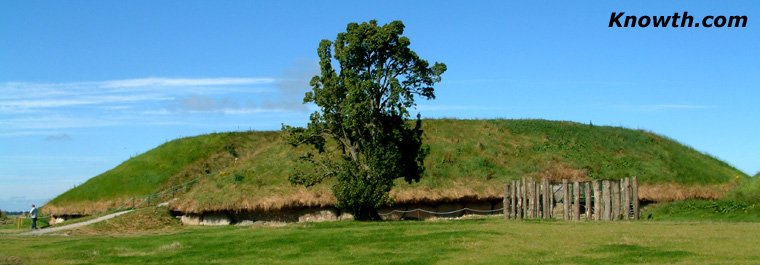 The Great Mound at Knowth in the Boyne Valley.