
Knowth Timber Circle
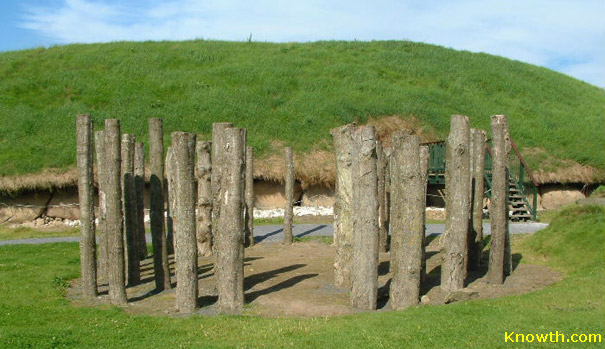 Timber circle or woodhenge at Knowth World Heritage Site.
Between 2800 BC and 2500 BC a timber circle or woodhenge was constructed near the eastern passage entrance at Knowth. The circle has been re-created using the 33 prehistoric post holes. This period is known as the Grooved Ware period, from a pottery type with a flat bottom and straight sides. Grooved pottery was found near the timber circle. Votive offerings were also found in and around it, suggesting ritual use, possibly after the Great Mound had fallen into disuse.
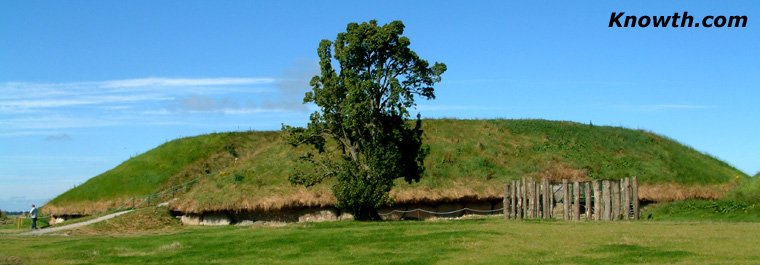 The Great Mound at Knowth.
The Great Mound was built over 5,000 years ago, probably after the construction of Newgrange and before the construction of Dowth. It is similar in size to Newgrange and is surrounded by 19 smaller satellite mounds. The mound has two passages with entrances on opposite sides: the western passage is 34 metres (112 feet) long and the eastern passage is 40 metres (131 feet) long, ending in a cruciform chamber.
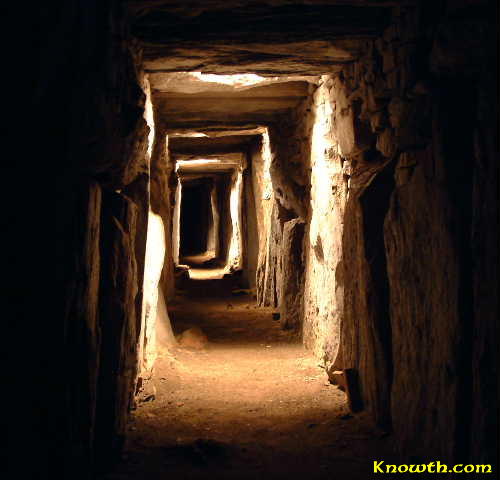 Eastern Passage at Knowth.
The eastern passage of the Great Mound at Knowth measures 40 metres (131 feet), making it the longest megalithic passage in Western Europe. At the end of the passage is a cruciform chamber with a corbelled roof similar in style to Newgrange.
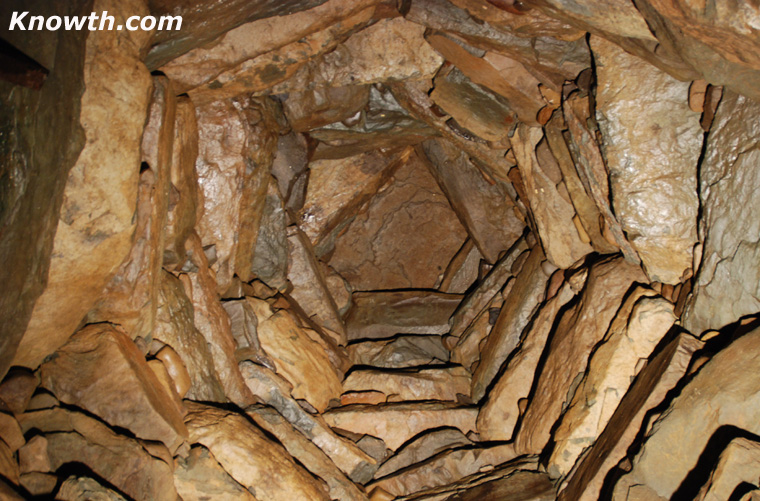 Corbelled roof over the chamber in the eastern tomb.