
Local Information
The Boyne Valley stretches across County Meath and southern County Louth, in the north-east of Ireland. Often described as the birthplace of Ireland's Ancient East, it combines deep archaeological time with rolling countryside, market towns and a dense cluster of places to visit. At its heart is Brú na Bóinne, the UNESCO World Heritage landscape of Newgrange, Knowth and Dowth, where passage tombs were built more than 5,000 years ago, centuries before the pyramids of Egypt.
Beyond the great mounds lie the Hill of Tara, monastic sites such as Kells and Mellifont, the Battle of the Boyne battlefield at Oldbridge, and the prehistoric cairns of Loughcrew. The Hill of Ward near Athboy is remembered as a centre of the ancient Samhain festival. The valley is easy to reach from Dublin Airport and sits on the network of the M1, M2, M3 and M4, with the rivers Boyne and Blackwater threading through much of the landscape.
 Newgrange, Brú na Bóinne World Heritage Site.
Boyne Valley Guide
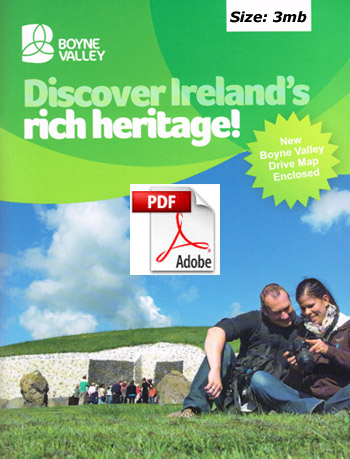
The free Boyne Valley Guide includes an enclosed drive map with numbered stops from Trim and the Hill of Tara east to Drogheda and Monasterboice, and west again toward Kells, Oldcastle and Loughcrew. Site notes sit close together in the landscape, so a single day can take in prehistoric tombs, early Christian monasteries, Anglo-Norman castles and later historic towns.
The guide presents the valley as Ireland's ancient capital and one of its most sacred and mythical landscapes. The River Boyne rises near Carbury in County Kildare, runs through the fertile plains of Meath and reaches the Irish Sea at Drogheda. Rich soils and a relatively dry east-coast climate drew Neolithic farmers from about 4000 BC, while the river itself long served as a route for food, travel and trade. Its name is linked with the goddess Bóann, and the Greek geographer Ptolemy recorded the Boyne as Bouvinda in the second century AD.
An archaeological and historical timeline runs from Mesolithic hunter-gatherers around 7000 BC through the Neolithic building of Newgrange, Knowth and Dowth (about 3200 BC) and the cairns at Loughcrew, to Iron Age and early Christian Meath, the Anglo-Norman arrival and Hugh de Lacy's castle at Trim, the Battle of the Boyne in 1690, and the UNESCO World Heritage listing of Brú na Bóinne in 1993.
Places covered in the guide include:
- Trim Heritage Town and Trim Castle, Europe's largest Anglo-Norman castle; Bective Abbey, Skryne, and Ardmulchan
- Hill of Tara, ceremonial focus of the High Kings, and Navan Town
- Brú na Bóinne: Newgrange and Knowth
- Duleek Abbey
- The Battle of the Boyne site at Oldbridge
- Drogheda Heritage Town, St Peter's Church (shrine of St Oliver Plunkett), Highlanes Gallery, Drogheda Museum at Millmount, and Beaulieu House
- High crosses and round tower at Monasterboice, and Old Mellifont Abbey
- Townley Hall, Francis Ledwidge Museum, Slane Village and Slane Castle
- Hill of Slane, linked with St Patrick's Paschal fire, and Dowth
- Donaghmore Round Tower, Donaghpatrick
- Kells Town and Monastic Site, associated with the Book of Kells
- Spire of Lloyd, Patrickstown Viewing Point, Oldcastle
- Loughcrew Gardens and Cairns
- Myths and Legends of the Boyne landscape
Download Boyne Valley Guide (PDF)
Guided Tours
Brú na Bóinne Visitors Centre is the starting point for guided tours of Knowth and Newgrange.
Boyne Valley Tours offers tailored private driver tours including Knowth, Newgrange, the Hill of Tara, Monasterboice and other heritage sites in County Meath and County Louth.
Boyne Valley
Discover Boyne Valley is the regional tourism site for County Meath and south County Louth. Use it for visitor information, maps and brochures, food and drink, walking and cycling routes, and what's on across the valley.
There is a wide range of accommodation in the Boyne Valley, from boutique hotels in Drogheda and modern stops near the M1, to country-house bed and breakfasts, self-catering cottages and farm stays, and hostels close to Newgrange and Slane.
Drogheda.ie covers Ireland's largest town on the Boyne: medieval walls and gates, museums and heritage sites, tours and trails, festivals and events, and outdoor activities in and around Drogheda as a base for County Louth and the lower Boyne Valley.
The Meath Archaeological and Historical Society promotes the archaeology, history and traditions of the ancient Kingdom of Meath. It runs lectures and publishes the annual journal Ríocht na Midhe.
The County Louth Archaeological and Historical Society, founded in Dundalk in 1903, studies the monuments, documents and past of County Louth and neighbouring districts. Members receive the society's annual journal and notice of lectures and excursions.
Slane Historic Trail
There is a wealth of heritage sites in Slane, and visitors to the town can follow a trail commencing at the Slane Cottages to learn more about the estate village of Slane, County Meath.
Slane Cottages
The Slane cottages are situated at Canon Row, often called Cavan Row after the labourers who came from Cavan to work on the Slane Estate. Locals also called it Lilac Lane after a lilac tree that once stood at the end of the row. These cottages were gifted to Meath County Council by Lord Henry Mount Charles in 2009.
The Village Square
Slane is one of the most attractive villages in Ireland. The Conynghams, a military family who rose to prominence in the time of William of Orange, created this Georgian village. The centre, known as the Square, has four identical Georgian houses built during the 1760s on land leased to private individuals by Viscount Conyngham.
Slane Castle
The building as it stands today dates from 1785. James Wyatt, James Gandon and Francis Johnston were all commissioned by William Conyngham to assist in the design. The estate was purchased by the Conyngham family in 1701 after the lands were forfeited by the previous owners, the Fleming family, in 1641, and it remains in the Conyngham family to the present day. In 1984 U2 lived in Slane Castle while recording The Unforgettable Fire. Ironically, in 1991 much of the castle was severely damaged by fire, but it has been restored to its former glory by Lord Henry Mount Charles.
Saint Patrick
It was on the Hill of Slane, according to ancient manuscripts, that Saint Patrick lit the Paschal Fire on Easter Eve in AD 433. St Patrick's fire challenged the pagan law that forbade the lighting of any other fire while the festive fire at Tara still burned. King Laoghaire was alarmed to see a fire lit on a prominent hill within sight of Tara and said that Patrick was not to be honoured in any way.
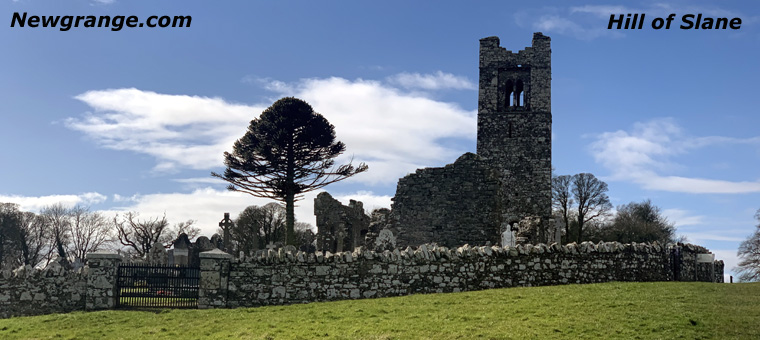 The Hill of Slane in the Boyne Valley.
Saint Erc
Erc was the only member of King Laoghaire's retinue to break ranks and pay homage to Patrick. Patrick baptised Erc and later consecrated him first Bishop of Slane. Tradition ascribes the foundation of the original monastery on the Hill of Slane to Saint Erc. In the graveyard stand two stones, the remains of a tomb of great antiquity known as Erc's Tomb. Saint Erc's foundation thrived in Slane and had an honourable history for at least six hundred years.
Dagobert
Legend has it that Slane Monastery was a place of sanctity and scholarship during the quieter centuries before the arrival of the Vikings and Normans. In 653, the King of Austrasia (a kingdom in eastern Gaul) died aged 21, leaving his two-year-old son Dagobert as heir. His chief ministers assumed control over the affairs of state and young Dagobert was sent to Slane Monastery to be educated. After twenty years Prince Dagobert returned home to become king.
The ruins on the hill today consist of a Franciscan church and college. They were erected by Christopher Fleming in 1512. The Fleming family were Lords of Slane for over 500 years.
Slane Mill
The flour mill and mill-house at Slane are two of the finest examples of industrial architecture in Ireland, completed by 1766. The mill was initiated through a business transaction between William Conyngham of Slane Castle, Blayney Balfour of Townley Hall and David Jebb, an engineer for the Boyne Navigation Company.
Local farmers supplied the mill with wheat. Once milled, the flour could be transported via the Boyne Navigation to Drogheda and on to home or foreign ports. From 1880 the mill was used as a coal depot. Towards the end of the First World War, flax scutching machinery was installed by Messers. Leitch, an Ulster firm. In the 1930s flour-bag cloth was produced. A new weaving factory opened in 1954, and a spinning mill was added in 1959. Weaving ceased in 1978, spinning in 1982, and the mill finally closed in 1983.
The Millhouse
In the early twentieth century, the millhouse ceased to be used as accommodation for the managers and operated as the Boyneville Hotel, catering for tourists who enjoyed pleasure trips along the canal from Oldbridge to Navan between 1905 and 1914. Since 1980 it has been owned by the Quigley family from Dundalk, who developed the Millhouse Hotel in 2006.