
Tomb L, Carnbane West, Loughcrew Hills
An archaeoastronomical assessment by Dr Frank Prendergast, College of Engineering and Built Environment, DIT.
The national monument known as Tomb L is situated on the summit of Carnbane West in the Loughcrew Hills. It is one of 15 passage tombs occurring within a broader complex of 32 megalithic monuments comprised of tombs, cairns and unclassified structures. With the exception of the nearby passage tomb in the adjacent townland of Thomastown, all are clustered on three hilltops including Carnbane East and Patrickstown.
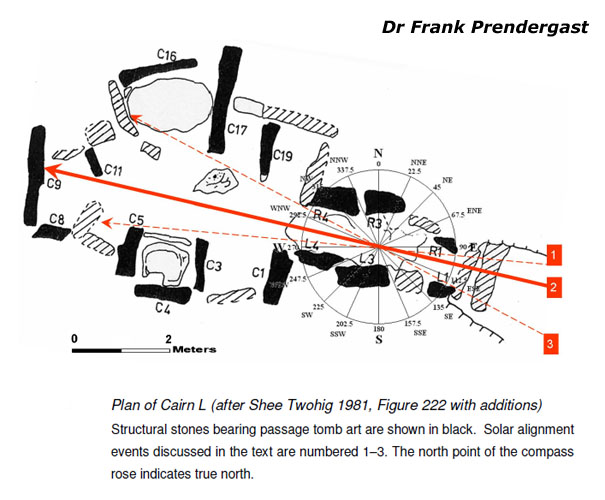 Plan of Cairn L (after Shee Twohig 1981, Figure 222 with additions).
Structural stones bearing passage tomb art are shown in black.
Solar alignment events discussed in the text are numbered 1 to 3.
Plan of Cairn L (after Shee Twohig 1981, Figure 222 with additions).
Structural stones bearing passage tomb art are shown in black.
Solar alignment events discussed in the text are numbered 1 to 3.
Tomb L is the dominant and most easterly tomb of the cluster on Carnbane West. It has a kerbed cairn with an eight-celled burial chamber and a corbelled roof. Two of the cells (or recesses) contain a basin stone but the right-hand of the pair is more emphasised in terms of the size of the basin stone and the embellishment on its back stone (C16). Within the cairn, 16 of the structural orthostats, two of the corbels, and two of the non-structural stones have passage tomb art incised on their obverse faces. Two of these also have hidden decoration (Shee Twohig 1981). The chamber is accessed by an easterly-facing passage.
The chamber and its art
Looking along the axial line from the entrance to the end recess (cell 4), cell 2 (which contains a basin stone) is bounded by orthostats C3 and C5 on either side of an entrance sill. In cell 4, the back stone C9 is flanked by C11.
The megalithic art on C9 is described by Shee Twohig (1981). On the left half of that stone there are three large horizontal in-phase serpentine motifs, with the top two joined at their ends on the right-hand side. Above these on the right there is a single and a double U motif. Shorter serpentine motifs also occur at the bottom of the stone. The only decoration on the left side is a damaged circle and some picking marks.
Cell 6 is the most elaborate in terms of its relative scale, the size of the basin stone, and the concentration of megalithic art. The back stone C16 bears concentric circles, nested U or arcs with a dot, triangles, lozenges, serpentine and parallel lines. Because the art covers the whole surface of the stone, it is sometimes described as being in the plastic style. Eogan (2011) additionally suggests that the main motifs possibly represent the head and body of an inclined stylised human figure.
Tomb orientation and archaeoastronomy
The chamber and passage are orientated east-south-east. There are no apparent distinctive topographical or monumental features on the horizon in this direction, which could suggest another reason for the orientation of the tomb.
Prendergast's summary investigation formed part of a national survey of passage tombs (Prendergast 2011). From the measured passage orientation (azimuth relative to true north), the horizon altitude and the geographical location of Tomb L, he calculated the indicative astronomical declination and the likely dates of sunrise for the north and south azimuth limits of the tomb (alignments 1 and 3 on the plan) and for the central axis (alignment 2). The dates below refer to the lower limb of the sun on the horizon, that is, when the sun has risen, and are accurate to about one or two days.
| Alignment | Phenomenon | Azimuth | Declination | Dates |
|---|---|---|---|---|
| 1 | Direct sunlight reaches cell 3 | 95° | -3.2° | 1 October, 11 March |
| 2 | Direct sunlight reaches cell 4 | 104° | -8.5° | 15 October, 27 February |
| 3 | Direct sunlight reaches cell 6 | 118° | -16.4° | 7 November, 4 February |
Although the azimuths were derived from compass bearings, the data are accurate enough to place the dates of solar illumination within the tomb to within a few days, and should match what an observer in the chamber would see.
Findings
The orientation limits of Tomb L lie within the annual range of sunrise and moonrise. The indicated declinations support these conclusions:
- the tomb is not aligned towards the winter or summer solstices;
- the tomb is not aligned towards the extreme (major) lunar limits;
- direct sunlight will reach the chamber at two periods of the year;
- when the sun is moving from north to south along the horizon (alignment 1 to 3), illumination begins around 1 October and ends around 7 November;
- when the sun is moving from south to north (alignment 3 to 1), illumination begins around 4 February and ends around 11 March;
- illumination of the end recess (alignment 2) would occur for a few days centred on about 15 October and 27 February;
- in all cases the phenomena should last roughly 15 to 20 minutes after sunrise, until the sun's disc is out of alignment with the passage and chamber.
The light pattern projected into the tomb depends on the shape of the entrance and the irregular orthostats in the passage. When the sun and the axis of the tomb are aligned, the out-view of the entrance gives an impression (if reversed) of the shape of light that would fall on the back stone C9.
Discussion
In the apparent absence of any distinctive natural or built horizon feature that might have acted as a target, Tomb L may simply have been built to face the rising sun. If so, that orientation would have ensured periodic illumination of the burial chamber after dawn on the dates in the table (with minor changes for the changing tilt of the Earth's axis).
Prendergast does not read these phenomena as calendrically significant in the prehistoric past, and challenges popular ideas that Tomb L is aligned on the mid-quarter dates of 5 November and 4 February. Although sunlight can reach the edge of cell 6 around those dates, claiming calendrical intent for the passage axis in early prehistory has little basis: the tomb is Neolithic and predates, by almost three millennia, late Iron Age or early medieval evidence for subdividing the solar year in that way. There is also little support for mid-quarter calendars in the wider Irish passage tomb tradition.
The solar illumination of Tomb L is a spectacular experience for those who see it, but is thought more likely to have been symbolic and related to the funerary role of the tomb than to a calendar. Focusing only on the northerly limit and its associated dates, while ignoring the broader period of up to five weeks when light enters the passage and chamber, is selective. Visiting at the dates and times described here still offers a rare chance to re-experience something close to what would have been seen when the tomb was in use around 3000 BC.
Download the original paper: Tomb L, Carnbane West, Loughcrew Hills: an archaeoastronomical assessment (PDF).
See also Cairn L, the limestone monolith inside the chamber, and the main Loughcrew page.