
Handcrafted paperweights and ornaments
These miniatures are no longer available to purchase. The images remain here as a record of the range.
 Miniature Ogham stones, Sheela-na-gigs, passage mounds and dolmens.
Handcrafted paperweights and ornaments in the minilithic range included miniature Ogham stones, Sheela-na-gigs, megalithic passage mounds and dolmens.
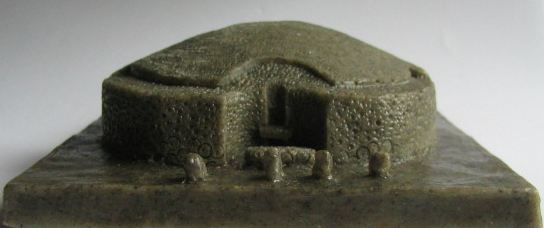 Newgrange Minilithic Paperweight, 4 x 4 x 1.25 inches.
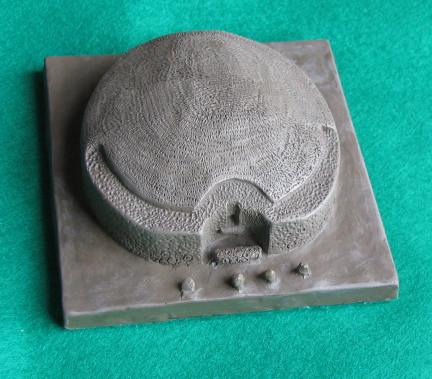 Bronze Minilithic Newgrange Passage Tomb, 4 x 4 x 1.5 inches.
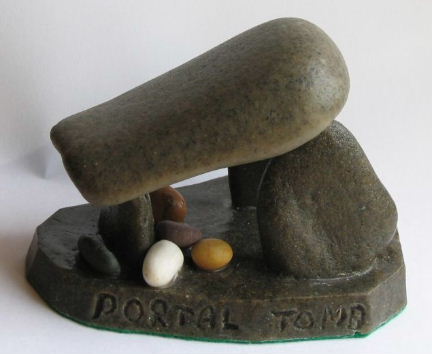 Miniature Dolmen (Portal Tomb), 4 x 3.25 x 2.75 inches.
What is a dolmen?
Stand before a dolmen and the first thought is often the same: how did anyone lift that stone? A dolmen is a megalithic chamber made of large upright stones with a heavy capstone balanced on top. In Ireland archaeologists usually call them portal tombs. The word dolmen itself comes from Breton, and it has stuck in everyday speech for the dramatic table-like tombs that still mark fields and ridges from Kerry to Antrim.
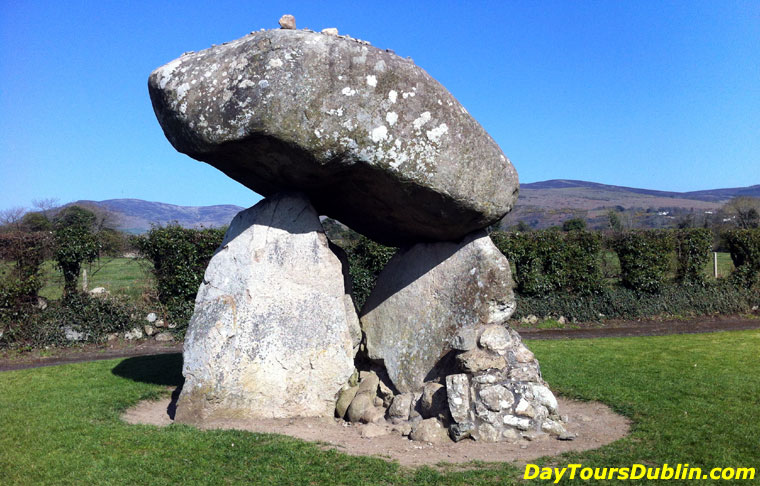 Proleek Dolmen,
a classic Irish portal tomb near Ballymascanlon, County Louth.
Proleek Dolmen,
a classic Irish portal tomb near Ballymascanlon, County Louth.
Most Irish portal tombs were built in the Neolithic, roughly between 3800 and 3200 BC, in the same broad age as early farming communities. That places them a little earlier, on average, than the great passage tombs of Newgrange, Knowth and Dowth in the Boyne Valley. Where a passage tomb hides its chamber under a mound of stone and turf, a dolmen leaves its skeleton open to the sky. Many once had a covering cairn of smaller stones. Centuries of weathering, farming and stone-robbing have stripped most of those away, which is why the uprights and capstone now look so stark.
How a portal tomb is built
The classic Irish form has two tall portal stones flanking the entrance, a lower backstone, and a sloping capstone that rests highest at the front. Side stones or orthostats close the chamber. Capstones can weigh many tonnes. Proleek, near Dundalk in County Louth, is a textbook example: two portals, a backstone and a capstone of about forty tonnes, still standing in open ground beneath the Cooley Mountains. Elsewhere the proportions vary. Some tombs are small enough for a single burial space. Others, such as Brownshill near Carlow, carry one of the largest megalithic capstones in Europe.
Moving stone of that size needed organisation, ropes, timber levers and a community willing to invest labour in a lasting place for the dead. Portal tombs are often set on slopes or ridges with wide views. That may have been practical, symbolic, or both. What is clear from excavation is that they were used for burial. Human remains, pottery and other grave goods have been found in several chambers, sometimes representing more than one generation.
Dolmens and other Irish tombs
Ireland's Neolithic tomb traditions sit in related families. Court tombs have long galleries and open courtyards. Wedge tombs, later in date, taper from front to back. Passage tombs, including those of Brú na Bóinne and Loughcrew, enclose a passage and chamber within a mound and often carry megalithic art. Portal tombs are the most instantly recognisable of the set: a stone table on legs. Folklore later filled the gaps science could not yet answer. Giants, Diarmaid and Gráinne, and fairy dwellings all became stories attached to lonely capstones in the landscape.
The miniature portal tomb in the minilithic range above was a small echo of that architecture, a cast reminder of a monument type that still defines much of Ireland's prehistoric skyline.