
Knowth Kerbstone K88
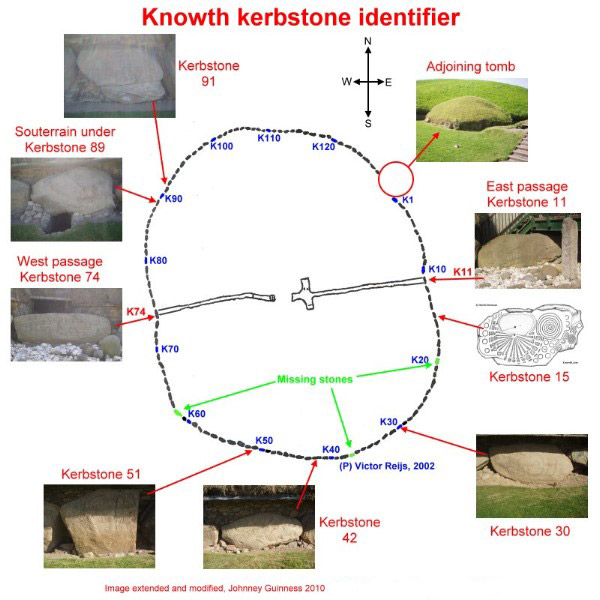
Kerbstone K88 is one of the 127 kerbstones numbered in Professor George Eogan's record of the Knowth monument. It is located on the north-western side of the great passage tomb mound.
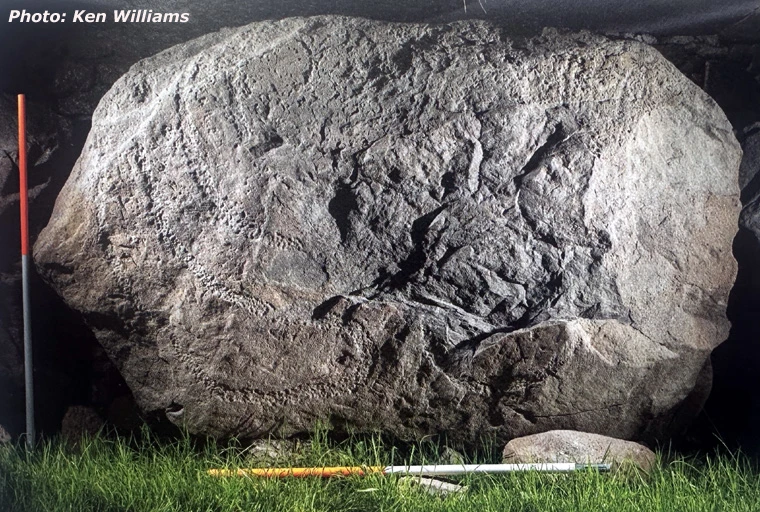 Knowth Kerbstone k88 | Photo by Ken Williams.
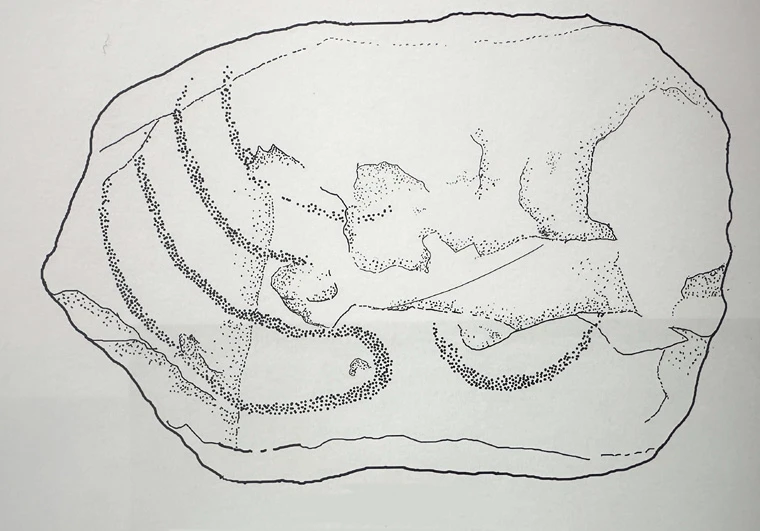 Knowth Kerbstone k88 Illustration | Published in Excavations at Knowth Volume 7.
The Megalithic Art of the Passage Tombs at Knowth, Co. Meath

Description of Kerbstone 88
Greywacke Stone, the upper-right section of the stone is badly spalled, with consequent loss of much of the carving. A large, circular motif is picked with a large, rounded point to a broad, ribbon-like band. Parts of four circular elements survive, the two inner ones now consisting only of short arcs, the two outer ones forming a loop on the left and facing what seems likely to have been a similar loop on the right.
Excavations at Knowth Volume 7: The Megalithic Art of the Passage Tombs at Knowth, Co. Meath
Purchase at Amazon.com or Amazon.co.uk. View or download at Digital Repository of Ireland.
Knowth Stone Age passage tomb
Kerbstone K88 is one of the stones encircling the Great Mound at Knowth, recorded in the numbered kerb sequence from K1 to K127. Guided tours include the kerb circuit; the passages and chambers are not open to the public. The stones are numbered K1 to K127 following Professor George Eogan's excavation record, published in the Excavations at Knowth series by the Royal Irish Academy.
Professor George Eogan opened excavations at the Great Mound and its satellite tombs in 1962. Within five years the western passage and chamber had been found; work soon after revealed a second passage and an extraordinary body of carved stone that accounts for a large share of Neolithic art in western Europe.
Decorated kerbstones were first recognised in quantity when R. A. S. Macalister cut an exploratory trench in 1941 and recorded fifty-eight kerbstones, most of them carved. His publication foreshadowed the fuller catalogue assembled during George Eogan's long campaign of excavation.
In sheer size Knowth rivals Newgrange. Building the mound demanded quarrying and moving thousands of tonnes of stone, shaping a ring of kerbstones, and fitting passages, chambers and cairn material into a carefully planned design that still impresses engineers and archaeologists today.