
Knowth Kerbstone K83
Kerbstone K83 is one of the 127 kerbstones numbered in Professor George Eogan's record of the Knowth monument. It is located on the north-western side of the great passage tomb mound.
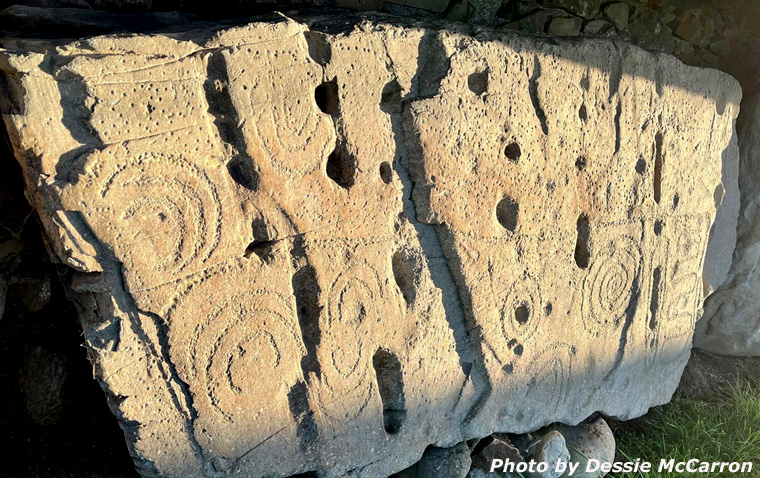 Knowth Kerbstone K83.
The Megalithic Art of the Passage Tombs at Knowth, Co. Meath

Description of Kerbstone 83
A large number of natural hollows, some round and some elongated, occur in slightly sloped, vertical rows. Many have picking around the edges, and some are incorporated into picked motifs. A horizontal line with close-set pickmarks runs across the middle of the stone. On the right, the line turns down alongside a natural hollow. At the left the line curves slightly downwards and ends at a flaked edge.
Above the line on the left two sets of three boxed Us are picked, one set opening to the lower left and the other opening upwards. Below the horizontal line there are three further sets of boxed Us on the left. To the right is a double circle enclosing a central hollow, a set of three arcs opening down to the left, and an anti-clockwise spiral of four-and-a-half turns.
To the right, a line of five natural hollows is enclosed in a long rectangle with rounded corners, and to its right again, is a vertical serpentiform, the bottom line of which curves upwards at the right and then downwards again. Much of the stone exhibits dispersed pickmarks made with a small- or medium-sized point. Some roughly vertical, parallel lines near the bottom edge are probably natural or the result of accidental damage.
Excavations at Knowth Volume 7: The Megalithic Art of the Passage Tombs at Knowth, Co. Meath
Purchase at Amazon.com or Amazon.co.uk. View or download at Digital Repository of Ireland.
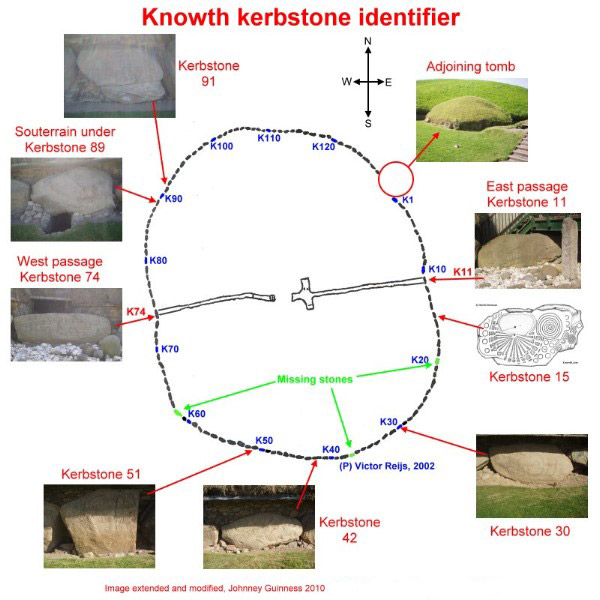
Knowth Stone Age passage tomb
Among the surviving kerbstones at Knowth, K83 contributes to the largest open-air gallery of Neolithic art in western Europe. Carvings on the end stone of the eastern passage have been interpreted as a schematic map of the moon's surface, among the earliest attempts anywhere to record the appearance of the lunar maria. Other motifs on the site may relate to eclipses and to the interplay of sun and moon in Neolithic reckoning.
Iron Age people buried their dead near the mound and built a substantial ring-fort settlement beside it, reusing a site that already carried great prestige. Later medieval farmers enclosed the summit within a grange, leaving traces still visible from the air.
The eastern passage runs for about forty metres, the longest known megalithic passage in western Europe. It opens eastward into a cruciform chamber with three recesses and a corbelled stone roof of the kind also seen at Newgrange (eastern tomb at Knowth).
Twin passages at Knowth face broadly east and west. Older ideas that they targeted equinox sunrises and sunsets have given way to wider interpretations that allow both solar and lunar observation, and perhaps calendrical counting, among the motives of the builders.