
Knowth Kerbstone K79
Kerbstone K79 is one of the 127 kerbstones numbered in Professor George Eogan's record of the Knowth monument. It is located on the north-western side of the great passage tomb mound.
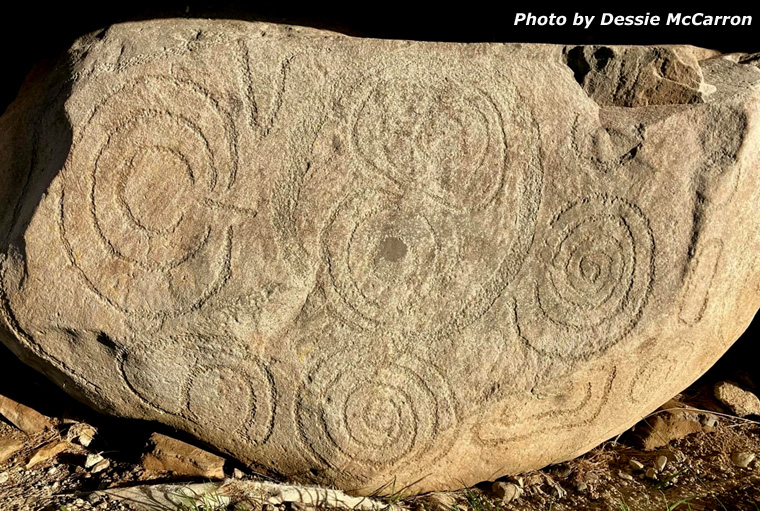 Knowth Kerbstone K79.
The Megalithic Art of the Passage Tombs at Knowth, Co. Meath

Description of Kerbstone 79
Stage 1: A lightly picked and somewhat weathered serpentiform runs across the middle of the stone and underlies some of the later carvings. Stage 2: A broad line curves along the left side of the face and turns onto the top, where it dips down to a V and then straightens to form a short, horizontal line. The line encloses a large double C-shape with a gapped circle inside; a short horizontal line is picked in the gap between the ends of the C. Below this is a comma-shaped motif.
To the right of the set of gapped ovals there is a large oval, picked with very wide, ribbon-like lines. This encloses two circular motifs, the upper a circle framed by two arcs on each side, with a similar motif below but with two concentric circles, and an arc only on the left. Below the oval is a clockwise spiral of four turns.
The next set of motifs, in the center of the stone, from the top downwards, are an upward-opening U-motif; a clockwise spiral of three turns, which is somewhat compressed laterally; and below this two wide, boxed, U-motifs. To the right, the next group of motifs has a circle at the top, with a narrow, upright rectangle and a double concentric circle below it. Most of the picking on this Stone is done with a small to medium-sized, rounded point.
Excavations at Knowth Volume 7: The Megalithic Art of the Passage Tombs at Knowth, Co. Meath
Purchase at Amazon.com or Amazon.co.uk. View or download at Digital Repository of Ireland.
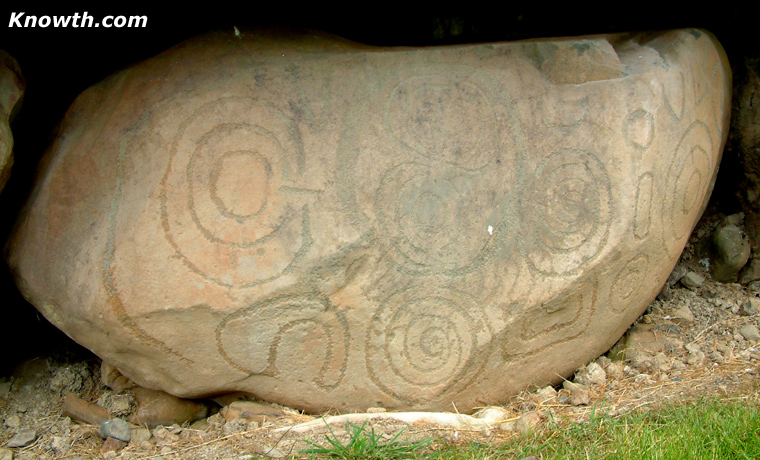 Knowth Kerbstone K79.
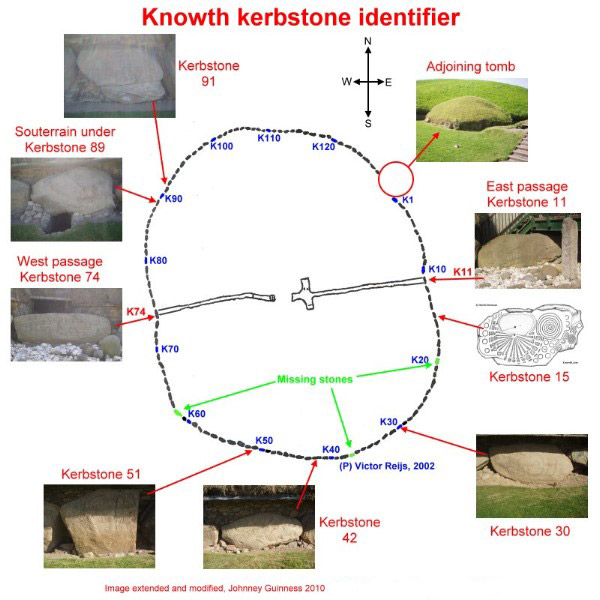
Knowth Stone Age passage tomb
Among the surviving kerbstones at Knowth, K79 contributes to the largest open-air gallery of Neolithic art in western Europe. No other site preserves so much carved Neolithic stonework in one place. After conservation of the mound, visitors on guided tours can walk the full kerb circuit and see one of the greatest open-air collections of prehistoric art in Ireland.
Guided tours include the kerb circuit; the passages and chambers are not open to the public. The stones are numbered K1 to K127 following Professor George Eogan's excavation record, published in the Excavations at Knowth series by the Royal Irish Academy.
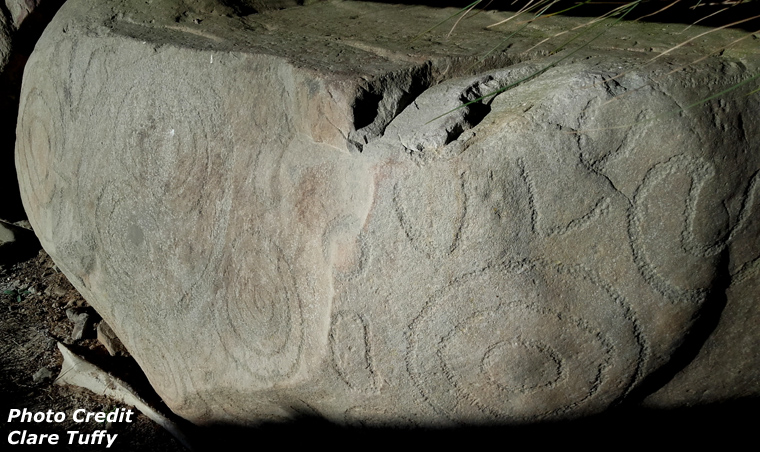 Knowth Kerbstone K79.
Professor George Eogan opened excavations at the Great Mound and its satellite tombs in 1962. Within five years the western passage and chamber had been found; work soon after revealed a second passage and an extraordinary body of carved stone that accounts for a large share of Neolithic art in western Europe.
Decorated kerbstones were first recognised in quantity when R. A. S. Macalister cut an exploratory trench in 1941 and recorded fifty-eight kerbstones, most of them carved. His publication foreshadowed the fuller catalogue assembled during George Eogan's long campaign of excavation.