
Rollright Stone Circle, Standing Stone & Dolmen
This complex of megalithic monuments lies on the boundary between Oxfordshire and Warwickshire, on the edge of the Cotswold hills. They span nearly 2000 years of Neolithic and Bronze Age development and each monument belongs to a different stage of the Neolithic and Bronze Age. The stones are local Jurassic oolitic limestone, the same Cotswold rock used for churches, houses and field walls in the district, and were probably gathered within a few hundred metres of the site.
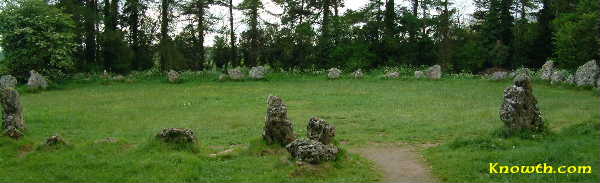 The Rollright King's Men Stone Circle.
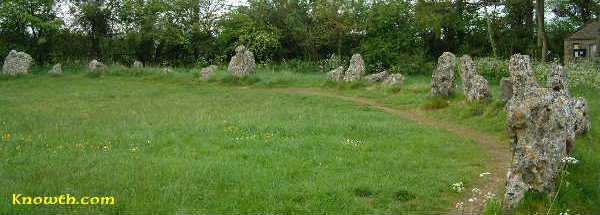 The Rollright King's Men Stone Circle.
The King's Men is a Late Neolithic stone circle raised around 2500 BC. Today some seventy heavily weathered limestone uprights and stumps form an irregular ring about 31 metres across. Folklore says the stones cannot be counted, and gaps in the ring likely mark places where stones were taken away over the centuries. The original ring probably contained around eighty closely spaced stones, although the exact number can never be known. When the site was first protected in the 1880s, fallen stones were stood up again, though not always exactly as before. Records from the seventeenth century onwards show that the ring was intended as a true circle.
Just outside the ring, two stones (one now fallen) mark a portalled entrance opposite the tallest upright. The circle stands on a very low bank with a wide gap on the entrance side, and the interior appears to have been levelled. Close-set stones, a portal entrance and a levelled floor are features shared with stone circles in the Lake District and a few in eastern Ireland, which suggests the builders brought a familiar design with them when they settled here.
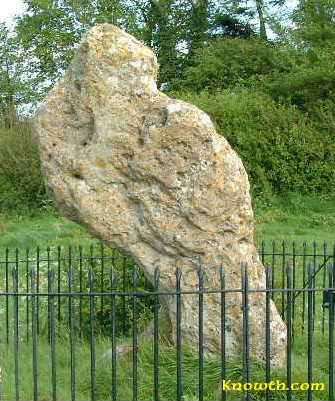 The King Standing Stone.
The King Standing Stone stands just across the road from the circle, a little below the crest of the ridge. Local legend says a king and his men were turned to stone by a witch after he failed to see Long Compton in the vale below.
The stone is thought to date from around 1500 BC. It most likely marked a nearby Bronze Age burial ground, including a round cairn on the ridge top, rather than serving as an outlier of the older King's Men circle.
The name may later have been linked to a meeting-place beside a substantial Saxon cemetery in the area, though the stone itself is far older. Its unusual outline, sometimes compared to a seal with a ball on its nose, owes less to weather than to nineteenth-century visitors and drovers who chipped pieces away as charms. That damage helped spur early legal protection for ancient monuments, and railings were soon put round the King Stone to stop further harm.
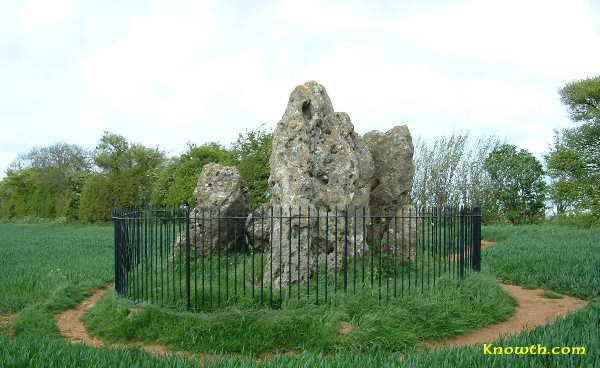 Whispering Knights Dolmen.
About 400 metres east of the circle stands the Whispering Knights, a portal dolmen burial chamber that probably predates the King's Men by more than a thousand years. Four uprights and a large fallen capstone remain. Three stones form a giant doorway facing down the hill, and that facade was likely meant to be seen from below. Further uprights once helped carry the capstone, which may have sat at a rakish angle like a table-stone. Excavation in the 1980s suggests the monument was free-standing rather than part of a long barrow, built to impress. The tall pillar on the left of the portal is the largest stone at Rollright, and moving the slabs with rollers, levers and sledges may have needed more than sixty people.
By comparison with similar tombs elsewhere, the chamber was among the earliest funerary monuments in Britain, perhaps built around 3800 BC. The roughly two-metre-square space would have held the disarticulated bones of several people. Pottery of Early Neolithic, Beaker and early Bronze Age date nearby shows the place continued to be visited, and a fragment of human bone washed from the chamber was radiocarbon dated to about 1700 BC.
The name comes from the same witch legend as the rest of the complex. The leaning portal stones look as if they are conspiring, or praying, which gave rise to the tale of treacherous knights. Although the central slab seems to prop the stones beside it, they do not actually touch: limestone dissolved over millennia has opened the gaps. Like the King's Men, the Whispering Knights were placed in guardianship in 1883, with railings added in 1894.
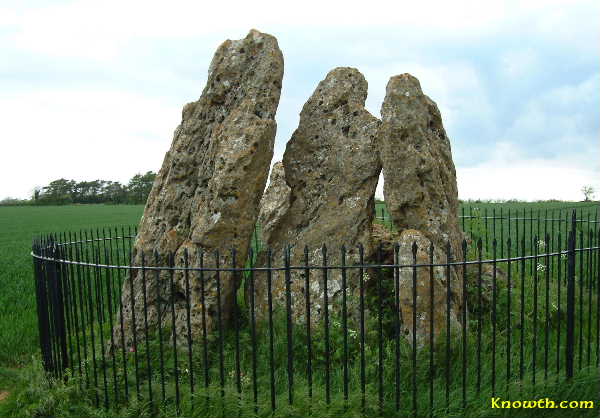 Whispering Knights Dolmen.
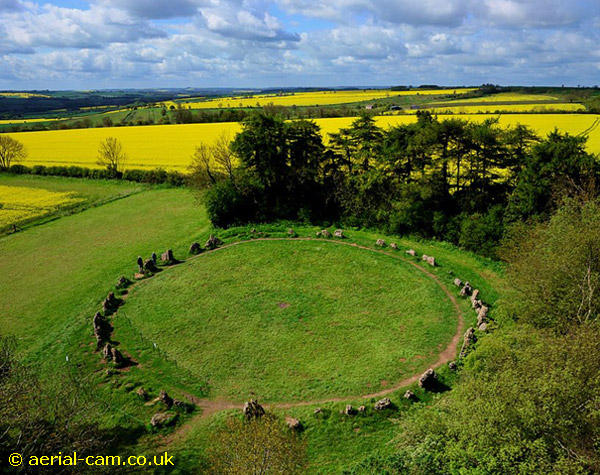 Rollright Stone Circle, photo by Aerial-Cam.
For more information on the Rollright Stone Circle, King Standing Stone and the Whispering Knights Dolmen visit the Rollright Stones Website.