
Labyrinth at the Anglican Cathedral, Liverpool
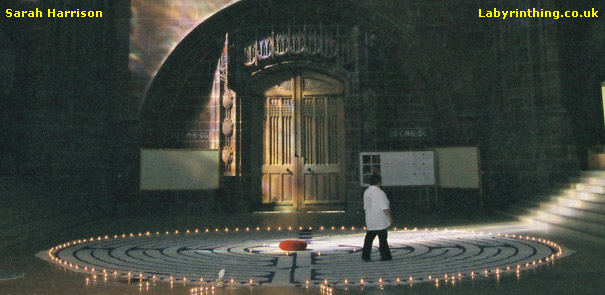 Chartres labyrinth replica at the Anglican Cathedral, Liverpool.
The canvas 11-circuit Chartres replica was laid out by Sarah Harrison and Eileen Wiggins.
Photo: Sarah Harrison.
Chartres labyrinth replica at the Anglican Cathedral, Liverpool.
The canvas 11-circuit Chartres replica was laid out by Sarah Harrison and Eileen Wiggins.
Photo: Sarah Harrison.
What is a labyrinth and what can it be used for?
The labyrinth is an ancient symbol of balance and wholeness. Walking a labyrinth will quiet the mind, bringing you to a place of calmness where you can elevate consciousness, connect with higher guidance, receive answers and facilitate physical and/or emotional healing.
Labyrinths have long been used as meditation and prayer tools. They have been associated with ancient pilgrimage routes and rituals of self-discovery. They have been worn as forms of protection and ornamentation, and they were often carved on doorways to bless a dwelling place.
When I mention the labyrinth most people think of a maze.
A labyrinth is not a maze. A maze is like a puzzle to be solved. It has twists, turns and dead ends. It is a left-brain task that requires you to be logical to find the correct path into the maze and out.
With a maze many choices must be made, and an active mind is needed to solve the problem of finding the centre.
A labyrinth has only one path. The way in is the way out. There are no dead ends and the path leads you to the centre and out again.
A labyrinth is a right-brain task that requires intuition, creativity and imagination.
With a labyrinth there is only one choice to be made: the choice is to enter or not.
There is no right or wrong way to walk a labyrinth. You only have to enter and follow the path. However, your walk can encompass a variety of attitudes. It may be joyous or somber. It may be thoughtful or prayerful. You may use it as a walking meditation.
"There are so many ways to walk a labyrinth, each unique as the people who come to walk it."
The original Chartres labyrinth
The pattern at Liverpool follows the great pavement labyrinth set into the floor of Chartres Cathedral in northern France. Laid in the early thirteenth century, most often dated around 1220, it is the largest intact medieval church labyrinth and the best known of its kind. Its diameter is about 12.9 metres (42 feet).
It is an 11-circuit design: a single path winds through eleven concentric rings to a six-petalled centre, then leads the walker out again the same way. A ring of small lunations, sometimes called cogs, frames the outer edge. In the Middle Ages such cathedral labyrinths were linked with pilgrimage. When travel to Jerusalem became difficult after the fall of the city in 1187, walking the pavement could stand in for an interior journey to the Holy City. Chartres was sometimes called the Chemin de Jérusalem, the road to Jerusalem.
A copper plate once marked the centre. It was removed and melted down during the French Revolution. Later writers said it showed Theseus and the Minotaur, a classical image that also appeared on other French cathedral labyrinths. Many similar pavements in France were destroyed in the seventeenth and eighteenth centuries. Chartres survived, and its pattern became the model for modern replicas worldwide, including the canvas walk at Liverpool.
See also Labyrinths in Ireland, the Ardbraccan labyrinth at An Tobar, and the Quadruple Labyrinth at Glore Mill.