
Knowth Kerbstone K118
Kerbstone K118 is one of the 127 kerbstones numbered in Professor George Eogan's record of the Knowth monument. It is located on the north-eastern side of the great passage tomb mound.
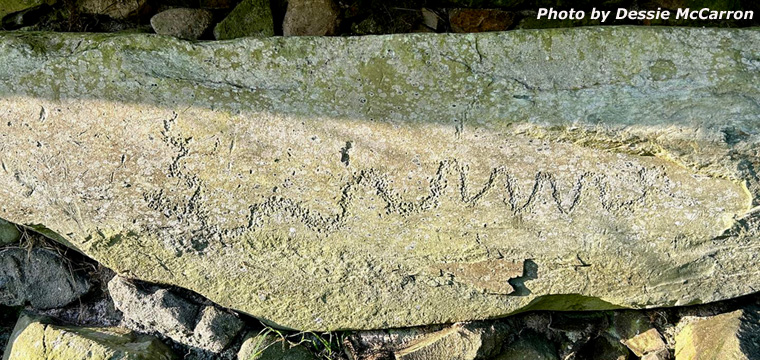 Knowth Kerbstone K118 | Photo by Dessie McCarron.
The Megalithic Art of the Passage Tombs at Knowth, Co. Meath

Description of Kerbstone 118
Across the middle of the stone, a horizontal serpentiform is picked with a medium-sized, rounded point. At the left end, the line widens and bifurcates, with a small, wavy line extending upwards. A short, sloping line is picked higher up on the stone.
Excavations at Knowth Volume 7: The Megalithic Art of the Passage Tombs at Knowth, Co. Meath
Purchase at Amazon.com or Amazon.co.uk. View or download at Digital Repository of Ireland.
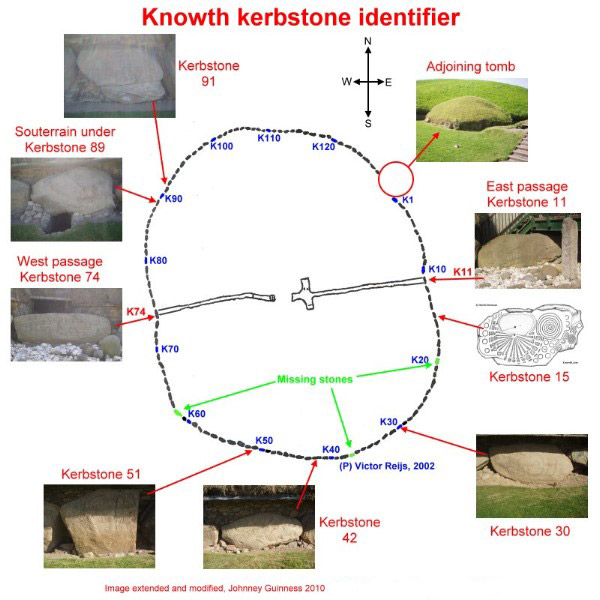
Knowth Stone Age passage tomb
K118 forms part of the ceremonial kerb documented during decades of excavation at Brú na Bóinne by Professor George Eogan and his team. Iron Age people buried their dead near the mound and built a substantial ring-fort settlement beside it, reusing a site that already carried great prestige. Later medieval farmers enclosed the summit within a grange, leaving traces still visible from the air.
The eastern passage runs for about forty metres, the longest known megalithic passage in western Europe. It opens eastward into a cruciform chamber with three recesses and a corbelled stone roof of the kind also seen at Newgrange (eastern tomb at Knowth).
Twin passages at Knowth face broadly east and west. Older ideas that they targeted equinox sunrises and sunsets have given way to wider interpretations that allow both solar and lunar observation, and perhaps calendrical counting, among the motives of the builders.
The passage tombs of the Boyne were designated a UNESCO World Heritage Site in 1993. Knowth, Newgrange and Dowth together represent one of the richest prehistoric landscapes in Europe, valued for their age, scale and megalithic art.