
Tara Samhain Sunrise
The Mound of the Hostages on the Hill of Tara is aligned to the rising sun around Samhain, when early November light reaches into a chamber built some 5,000 years ago. That solar design ties Tara's prehistoric calendar to the later festival night that became Halloween.
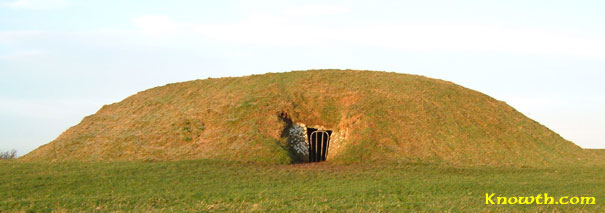 Mound of the Hostages on the Hill of Tara.
Light in the Mound of the Hostages
Samhain falls at the cross-quarter of the year, roughly midway between the autumn equinox and the winter solstice. The passage of the Neolithic Mound of the Hostages is also aligned near Imbolc in early February, so these seasonal thresholds already mattered in stone long before later Irish tradition made Tara a seat of kingship.
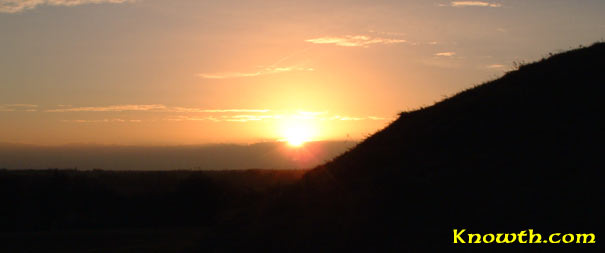 Samhain Sunrise at the Mound of the Hostages.
Samhain solar alignment
The chamber photograph below was taken on 13 November 2005, about a week after the cross-quarter day. The short passage lets low November sunlight into the chamber for several mornings around Samhain. What the photographs show clearly is light on the side stones of the chamber, with striped shadows from the modern iron gate at the entrance. The one decorated orthostat is a side stone too, not a lit backstone of the kind seen at Loughcrew Cairn T.
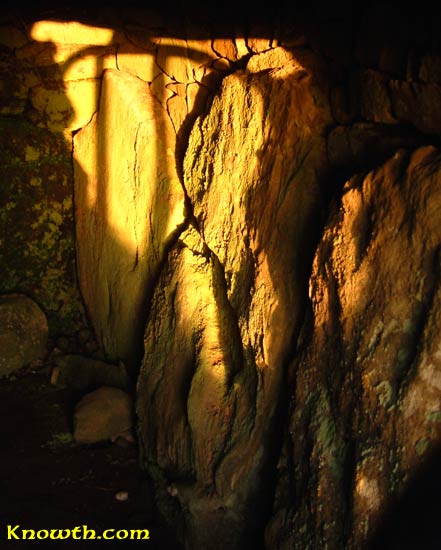 Mound of the Hostages at 8:07am on 13 November 2005.
Samhain and the Hill of Tara
In early Irish tradition Samhain closed the harvest and opened winter, a night when the boundary between this world and the Otherworld was thought to thin. Livestock came in from pasture, communities gathered, and early medieval texts treat the festival as a moment of danger and opportunity, when kingship could be challenged and fate reshaped. Among the places tied to that night, Tara holds a particularly strong claim.
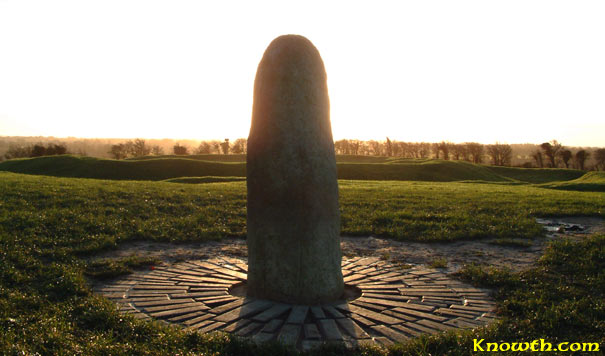 Lia Fáil in the Samhain sunrise, now standing on the King's
Seat or Forrad, the stone once stood in front of the entrance to the Mound of the Hostages.
Lia Fáil in the Samhain sunrise, now standing on the King's
Seat or Forrad, the stone once stood in front of the entrance to the Mound of the Hostages.
Kingship and Samhain night
Tara was a ceremonial landscape of sovereignty and law, remembered as the symbolic seat of the High Kings even when real power lay elsewhere. Seasonal assemblies and royal inaugurations were tied to the calendar, and Samhain stood out as a night when the relationship between king, land and people was tested. Stories bring supernatural visitors to Tara on Samhain night to challenge the household, so a king's ability to keep order becomes a measure of his harmony with the land. Renewal and fear sit side by side. The old year ends, and the next begins only if balance holds.
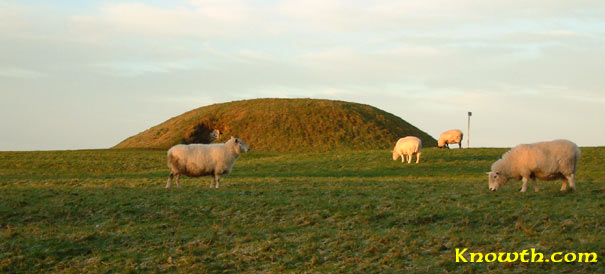 Sheep grazing on the Hill of Tara in the Samhain sunshine.
Neolithic monuments, later earthworks and early medieval tradition all meet on the same hill. Standing there in late autumn, with shortening days and low light, it is easy to see why Samhain and Tara became so closely bound in the Irish imagination.
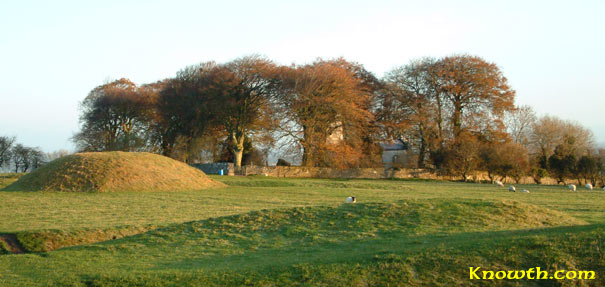 Samhain sunrise on the Hill of Tara viewed from King's Seat or Forrad.
Samhain in early Ireland
Beyond Tara, Samhain was a major seasonal festival across early Ireland, marking the end of summer and the start of winter. It fell around 1 November, though celebrations began on the night before, the eve that later became Halloween. Folklore remembers it as a threshold time, when spirits, ancestors and fairies might cross more freely between this world and the Otherworld. Bonfires, feasting and household customs of welcome and protection grew around that night.
In the Boyne Valley the fire traditions of Tlachtga sit alongside Tara's solar and royal associations, while All Hallows and All Souls later gave the season a Christian frame of remembrance for the dead. Irish emigrants carried Halloween customs to America in the nineteenth century, where they took on new forms. For a fuller account of the festival, its folklore and its Boyne Valley setting, see Samhain on Newgrange.com.