 On March 17, 1980, Martin Brennan and Jack Roberts saw a beam
of light from the rising sun illuminate a carved stone at the back
end of the rock-lined passage in the great mound called Cairn T at
Loughcrew, County Meath. Two weeks later,
on the evening of the first of April, Brennan and his colleagues watched the rising moon
from the same spot. As the moon appeared over the horizon a shaft
of light was projected along the passage and onto the same carved stone.
On March 17, 1980, Martin Brennan and Jack Roberts saw a beam
of light from the rising sun illuminate a carved stone at the back
end of the rock-lined passage in the great mound called Cairn T at
Loughcrew, County Meath. Two weeks later,
on the evening of the first of April, Brennan and his colleagues watched the rising moon
from the same spot. As the moon appeared over the horizon a shaft
of light was projected along the passage and onto the same carved stone.
The great passage mound of Knowth, also in Meath, contains two rock-lined passages, one facing east, the other west. Brennan observed the setting sun shine into the western passage on September 13, 1980. Attempting to observe sunrise on the following day, he found that the view of the rising sun from the eastern passage would be blocked by trees and the current level of the ground. Nevertheless, it seems likely that the eastern passage was also originally intended to be penetrated by light from the rising sun and moon. Although solar alignments have been described at many Neolithic sites in Western Europe, less attention has been paid to lunar alignments, despite the fact that at certain times the moon can rise or set at any location on the horizon which may be occupied by the sun.
Brennan's experience, described in his 1983 book The Stars and the Stones, suggested that these Irish Neolithic sites might have had some connection with the moon as well as the sun. I have identified another connection, previously overlooked by Brennan and others working at Knowth. If moonlight were to shine on the back stone of the eastern passage at Knowth, it would illuminate a map of the moon itself, the world's oldest known depiction of the lunar maria.
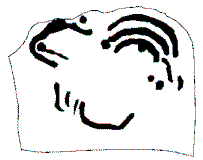 The carved stone which forms the end wall of the eastern
passage was called Orthostat 47 by George Eogan, who excavated
Knowth in the 1960s. The design has three sections,
superficially similar but oriented differently. The right-hand
section appears to be nothing less than a map of the lunar maria,
as becomes clear when it is compared with a naked-eye map of the
moon. At least a dozen points of correspondence are immediately obvious.
The carved stone which forms the end wall of the eastern
passage was called Orthostat 47 by George Eogan, who excavated
Knowth in the 1960s. The design has three sections,
superficially similar but oriented differently. The right-hand
section appears to be nothing less than a map of the lunar maria,
as becomes clear when it is compared with a naked-eye map of the
moon. At least a dozen points of correspondence are immediately obvious.
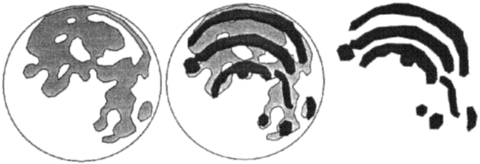
A naked eye map of the moon (left), a carving from Knowth Orthostat 47 (right)
and the two superimposed (centre) to illustrate their similarity.
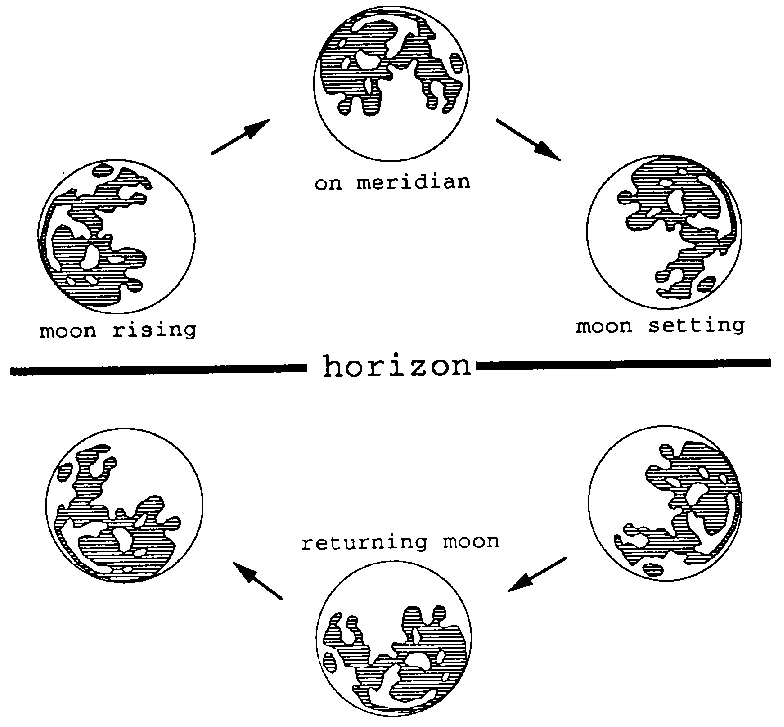
The right-hand carving on Orthostat 47 depicts the maria as seen on a full moon a little after midnight. At upper left the maria are shown soon after moonrise. It would be reasonable to assume that the lunar disk continues to rotate beneath the horizon, and the carving at lower left appears to show the maria 'upside down' as if under the horizon. The only thing missing is a clear outline of the circular limb of the lunar disk. Perhaps it was originally chalked or painted on the rock.
Here on one stone are two important lunar observations, representations of both the maria themselves and their apparent rotation as the moon crosses the sky. Further examples of both are found at Knowth. One of the most diagnostic is Kerbstone 52 (as designated by Eogan. Brennan called it SW22 or the 'calendar stone'). On it a group of crescent shapes are arranged around the large boulder.
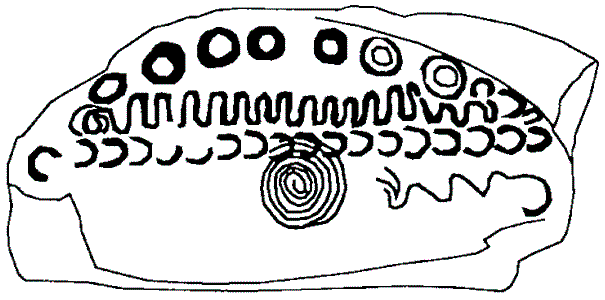
Seven of the crescents at the top of the stone are replaced by circles. Brennan interpreted the crescents and circles as phases of the moon, though the characteristic first and last quarters are not convincingly portrayed. However, the crescents are not oriented as an actual lunar crescent would be in any obvious sequence of observations. Rather, their positions match the orientation of the maria as the full moon crosses the sky. Why do they turn to circles at the top of the stone? I attribute this to the excessive contrast between the brilliant full moon and the black night sky, which renders the maria harder to see than at dawn and dusk.
Near the base of Kerbstone 52 the crescents dip below a wavy line (a schematic horizon of waves or hills?) and pass horizontally back to the starting point to complete the cycle. Brennan interpreted the cycle as a month, whereas I see it as the daily motion of the moon. There are 29 symbols, the number of whole days in a lunation, but that number, obviously associated with the moon, does not by itself prove that the design is a depiction of a month. The symbols cross a spiral which may represent the moon's path through the heavens at a different elevation each month during the year. Here again we see the maria represented by an arc, whose changing orientation corresponds to the apparent rotation of the lunar disk during a night. This general pattern, in various forms and less fully developed, is repeated elsewhere at Knowth and at Loughcrew, Newgrange, Dowth and perhaps at Gavrinis in France.
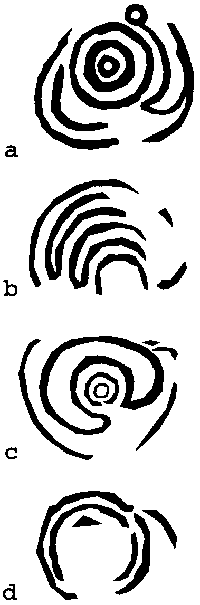
The overall pattern of lunar maria from Humorum and Nubium past Imbrium to Nectaris and Fecunditatis may be seen as one broad arc. Alternatively, the eastern maria (Crisium, Nectaris and Fecunditatis) suggest a three-fold subdivision of the arc. This is extended westwards by Mare Frigoris, and the three-fold division is again suggested (a little less obviously) by south-western Oceanus Procellarum, Mare Humorum and Mare Nubium. Thus, various combinations of arcs might be interpreted as lunar maps. Several of the most complex examples are shown in the diagram to the right.
One of the most interesting of these additional maps is that carved on a stone basin which Eogan discovered in the right-hand recess of Knowth's eastern passage. This shows a set of concentric circles (Mare Imbrium and its surrounding highlands), multiple lobes to the left and right (Oceanus Procellarum and the western maria respectively) and a small isolated circle near the top (Mare Crisium or possibly the eastern end of Mare Frigoris).
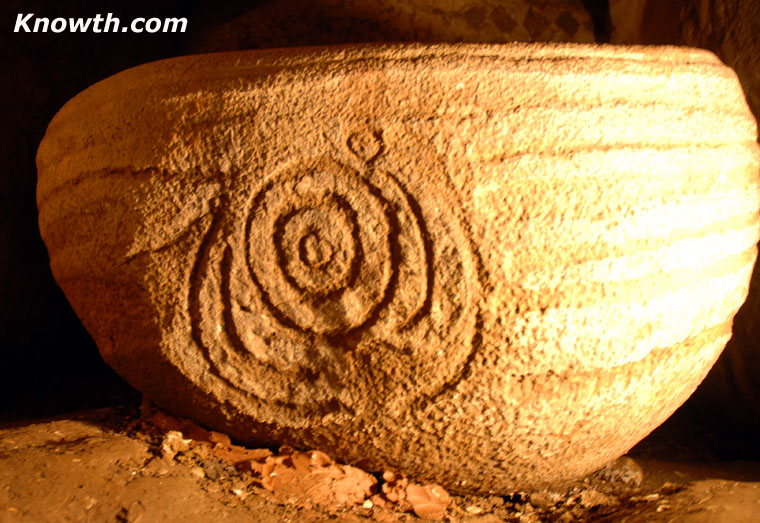
Basin Stone from the eastern chamber at Knowth
All these carvings, but especially the map on the stone basin and the carvings on Orthostat 47, which might have been illuminated from time to time by the moon itself, suggest that the markings on the moon - as well as the moon itself - were important to the builders of Knowth. God, home of the gods or of departed spirits? We will never know, but we can be certain that the builders of Knowth were keen observers of the sky. Without using sophisticated mathematics or fine angle measurements (as suggested by Alexander Thom and others), these neolithic astronomers were able to observe, depict and hypothesize about the moon and its motions. These are the actions of scientists.
Possible lunar maps:
(a) Stone basin found in the eastern passage at Knowth.
(b) Knowth Kerbstone 97.
(c) Knowth Kerbstone 68.
(d) Stone G, Baltinglass, Co. Wicklow.
The carvings are about 4800 years old. The next oldest depiction of the maria known to science is that by Leonardo da Vinci in about 1505 AD. Other ancient lunar maps may lie unrecognised among neolithic (and later) artifacts. For instance, I note that the plan of Stonehenge is itself very like the shapes I have described - a circle containing a horseshoe - and so might be considered a very simple map of the moon. Its famous solar alignment happens every year, but at certain times the full moon would also rise over the Heel Stone, and would illuminate a map of itself. This, of course, is even more speculative than the Knowth alignment, and it is also somewhat more recent than Knowth.
For now the products of the artists - and scientists - of Knowth are by far the oldest apparent representations of lunar markings and motions known to us. Their significance to the history of science is considerable. Knowth is one of the most important ancient scientific sites in the world.
Lastly, I will raise a still more speculative matter. The historian Diodorus Siculus (writing shortly before the time of Christ but quoting Hecataeus, some five centuries earlier, 'and certain others') wrote of the 'Island of the Hyperboreans':
... there is also on the island both a magnificent sacred precinct of Apollo and a notable temple which is adorned with many votive offerings and is spherical in shape... They say also that the moon, as viewed from this island, appears to be but a little distance from the Earth and to have upon it prominences, like those of the Earth, which are visible to the eye. The account is also given that the god visits the island every nineteen years....
The nineteen year period is presumably that between almost identical eclipses. The spherical temple has usually been assumed to refer to the circular Stonehenge, but might equally well refer to Knowth or Newgrange, which being prominent mounds at least resemble hemispheres. Newgrange appears to have been partly covered with white quartz fragments, giving the appearance of an egg (according to Brennan) or of the shining moon itself. Quartz is also found at Knowth and Dowth. Its original distribution at each site is uncertain. Were the mounds themselves decorated to look like the moon? This deserves further study. The 'prominences' referred to are presumably the lunar maria visible to the eye, and the reference to them at least indicate a local interest in those markings which is more in evidence at Knowth and Newgrange than at Stonehenge. The text may even be a confused reference to the very carvings which are the subject of this article.
A more complete account of this research, but lacking the section on passage geometry, is to be found in: Stooke, P.J. "Neolithic Lunar Maps at Knowth and Baltinglass, Ireland". Journal for the History of Astronomy, XXV: 39-55, 1994.
Dr. Philip Stooke 1994
Boyne Valley Private Day Tour
 Immerse yourself in the rich heritage and culture of the Boyne Valley with our full-day private tours.
Visit Newgrange World Heritage site, explore the Hill of Slane, where Saint Patrick famously lit the Paschal fire.
Discover the Hill of Tara, the ancient seat of power for the High Kings of Ireland.
Book Now
Immerse yourself in the rich heritage and culture of the Boyne Valley with our full-day private tours.
Visit Newgrange World Heritage site, explore the Hill of Slane, where Saint Patrick famously lit the Paschal fire.
Discover the Hill of Tara, the ancient seat of power for the High Kings of Ireland.
Book Now
Home
| Newgrange
| Knowth
| Dowth
| Hill of Tara
| Fourknocks
| Loughcrew
| More Places
| Labyrinths
| Local Info
| Art Works
| Articles
| Images
| Books
| Links
| Boyne Valley Tours
| Contact